⚠️ Due to an outage our Northwood will call is closed today. | We're still processing orders. | If you need assistance, please contact us.




$74.45
ea.
$74.45
for
1
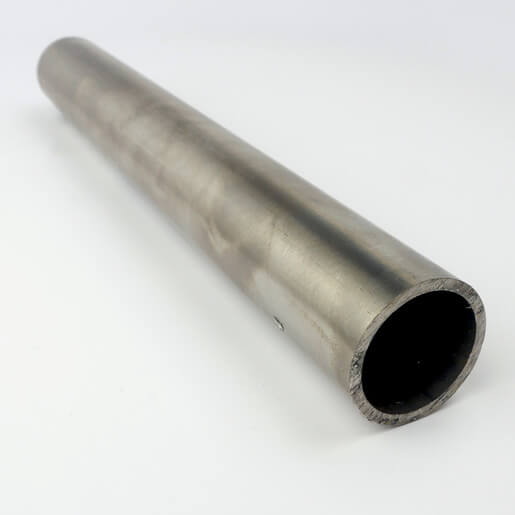
1" OD x 0.028" Wall x 0.944" ID Stainless Round Tube 321 SeamlessPart #: 28434
Dimensions:
- Outer Diameter: 1 "
- Wall: 0.028 "
- Inner Diameter: 0.944 "

Pricing and availability for this item changes frequently. Contact us now for a fast quote.
Stainless Round Tube 321 provides high strength, high temperature capability, and resistance to intergranular corrosion. 321 resists scaling at higher temperatures. Also, the addition of titanium means that welding is not suggested for this alloy. It is typically used in aerospace and defense for engine parts, heat exchangers, missile components, exhaust stacks, rocket engines, manifolds, and more.
 MTR
Available
MTR
Available

Product Information

Please note:

Please note that this data is to be used ONLY FOR REFERENCE, NOT FOR DESIGN, and by using it,you agree that any decisions you make regarding materials for your project are at your own discretion.
Outer Diameter
1
Wall
0.028
Inner Diameter
0.944
Alloy
321
Production Method
Seamless
Metal Type
Stainless Steel
Shape
Tube-Round
Yes
RoHS
Yes
REACH
Yes
Weight/Lineal Foot
0.2924 pounds

Mechanical Properties
Density g/cm^3
8
Rockwell Hardness B Scale
91
Elongation % in 2 in.
42
Ultimate Tensile Strength KSI
93
Brinell Hardness 3000 kg load
190
Yield Tensile Strength KSI
42
Shear Strength KSI
64
Electrical Conductivity % IACS
2
Melting Point °F
2550 - 2600
Machinability %
36

Chemistry Information : 321 Stainless Steel
Element
Percentage
Element
Percentage
Element
Percentage
C
0.08
Cr
18
Fe
68
Mn
2
P
0.045
S
0.03
Ni
11
Si
1
Ti
0.15

This stainless steel round tube has an outer diameter of 1 inch, a wall thickness of 0.028 inches, and an inner diameter of 0.944 inches. It is made from alloy 321 stainless steel, known for high strength and resistance to intergranular corrosion.
Yes, alloy 321 stainless steel provides excellent high-temperature capability and resists scaling at elevated temperatures, making it ideal for aerospace, defense, and heat exchanger applications.
Yes, custom cut options are available from the warehouse, with lengths ranging up to 240 inches. Multiple length variants are offered to suit your project needs.
Yes, MTR (Material Test Reports) are available for this product, ensuring traceability and compliance with quality standards.
Welding is generally not suggested for this alloy due to the titanium content, which helps resist intergranular corrosion but affects weldability.
You Have Added QTY to Your Cart
Product Name Part #

Dimensions
Size:


 Continue modifying your quoted cart?